A dive into the women of Agamemnon and how their actions are not perceived as justified and their motives are called into question.
To begin we will address the three main women in Agamemnon. The first and most controversial of the women being Helen of Troy. The daughter of Zeus, the woman blamed for the Trojan war, and for the many bad decisions of men and their armies. Helen has a very interesting story to tell, that the plot of Agamemnon does not cover. Click here to learn more about Helen of Troy . In the context of words uses to describe the actions and characteristics of Helen. These include catastrophe (The Orestreia: Agamemnon Line 409), reckless (The Orestreia: Agamemnon Line 412), and lust (The Orestreia: Agamemnon Line 417). These are not positive words and do not instill happiness or any positive attributes to Helen and any women for that matter. This is a common theme is Agamemnon as well as other ancient text, expanding past Grecian text. While think about this choice to describe women is such a way it made me think about a news profile on Taylor swift where she speaks on sexism in the music industry.
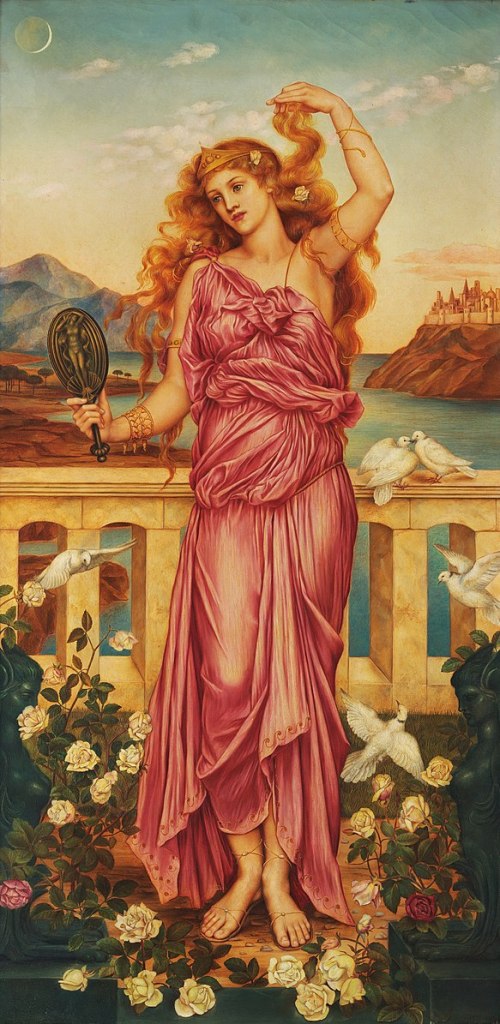
I think from this we can see that even still today language is power and the labels we use to describe women change how they are perceived. Focusing back agin on Helen of Troy, called “The Face that Launched a Thousand Ships”. This label placed on her forever is saying that she weaponized her beauty to cause a massive war, when in reality she mad decisions and other reacted to those decisions. During a time when beauty was one of the few things a women had to gain advantage, we blame her for “using” it, and at that using it to justify the behavior of men.
Moving on to the two main female characters of Agamemnon, the wife of Agamemnon and woman responsible for running Argos, while her husband was away at war. Her name was Clytemnestra, and she was a very ambitious woman, who was said to have run everything “like a man”, but when she takes it upon herself to be violent like one she is basically told she was overreacting, and her motives are called into question While away at war her husband needed to make a sacrifice, and chose his daughter as a means to win a war, the chorus of the play says, ” And so he steeled his hand to grasp his daughter’s sacrificial blade, did this all to support a war of vengeance for a woman’s bed” (The Orestreia: Agamemnon Lines 226-229). In this context Agamemnon’s actions are justified, because we will sacrifice anything for God any country.
However later on in the play when Clytemnestra eventually kills Agamemnon, the choir questions her, “I am astounded at your brasen tongue —- your bragging like this over you own husband” and she responds with, ” You patronize me like some little women with no mind to call her own.” (The Orestreia: Agamemnon Lines 1399-1403). I was shocked by this part not from the chorus but from Clytemnestra, because of how she speaks poorly of other women who have no brain and no sense, almost like she has been trained or convinced that is what women typically are and she is just not typical.
Though this is just the surface level of women in ancient text and even some insight today of how labels are used to put women in a box of bad connotation, thanks Taylor Swift for that explanation. One important thing to consider is that translations of ancient text vary and so might the labels that these women bare in them. As we can see from above that the words used to describe women like revenge and the words used to describe men like justice might be for the same action, but are intended to divide the genders leaving women with the connotation of manipulation, evil, and premeditation. All the while the men get to be the knight in shinning armor getting justice.
Take a look at my translation:
The Orestreia: Agamemnon. 1st ed., W.W. Norton and Company, 2016.
Link to more about Helen of Troy:
“Helen of Troy – Mythopedia.” Mythopedia, mythopedia.com/topics/helen.
 Cat's Core Collective